DEGIRO Hidden Fees 2026: FX Costs, Connectivity Fees, and Real Annual Drag
DEGIRO can look cheap on headline commissions, but FX conversion, connectivity fees, and execution drag add up. Estimate your real annual DEGIRO cost stack.
Posted by
 Moses
MosesRelated reading
Weekly Portfolio Review Checklist for Multi-Broker Investors
A practical weekly portfolio review checklist for investors with multiple brokers, currencies, dividends, fees, and recurring contributions to track.
Broker Fee Comparison for European ETF Investors: 5 Real Scenarios
Compare broker fees for European ETF investing with 5 real scenarios, then route your decision into the live comparison tool and fee-drag calculator.
Best Way to Track an ETF Portfolio Across Brokers (2026)
Looking for the best way to track an ETF portfolio across brokers? Use a workflow that captures real returns, dividends, fees, and FX drag instead of dashboard noise.
DEGIRO Hidden Fees in 2026: Why FX Cost Beats Headline Commission
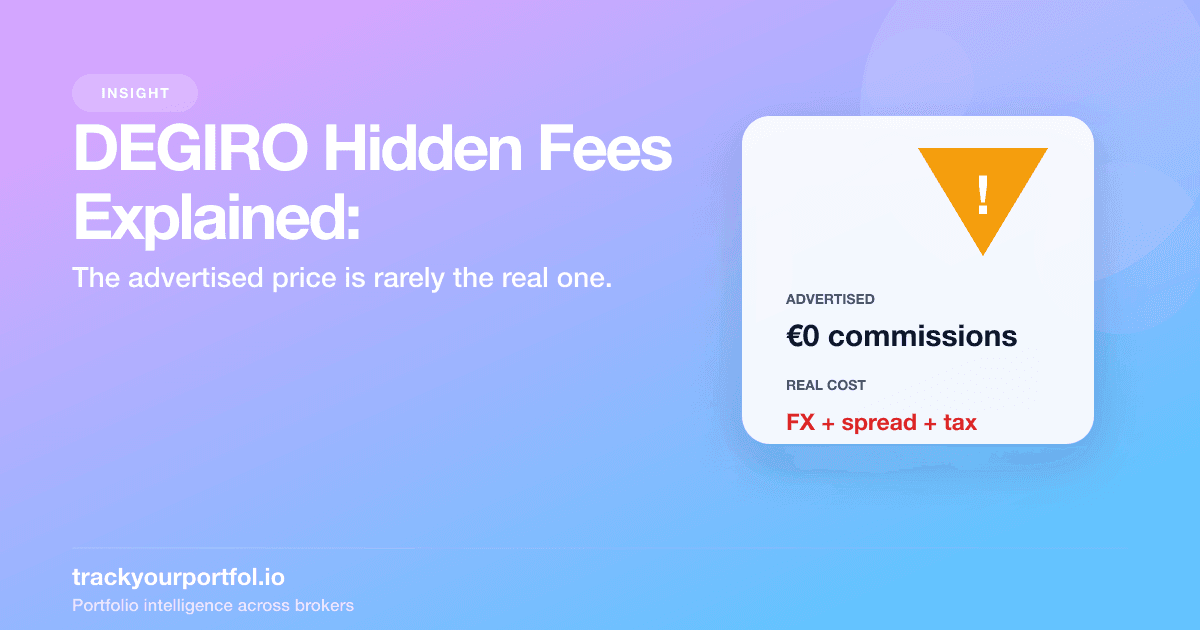
DEGIRO can be cost-effective for many investors, but "cheap per trade" does not always mean "cheap portfolio over time." For many European investors buying USD-denominated ETFs or stocks, the real drag starts with the 0.25% FX conversion charge, not the visible commission line.
The useful question is not whether DEGIRO looks cheap in marketing copy. It is: what do FX conversion, exchange connectivity, commissions, and execution drag cost you over a full year as a percentage of invested capital?
If you only track visible commissions, you miss the recurring costs that compound quietly: FX conversion, connectivity, and execution quality. That is why a broker that feels cheap at trade level can still be expensive at portfolio level.
Map The Full Cost Stack
Use these buckets to build a complete cost view before deciding if your setup is efficient:
- Trading commissions: explicit per-order charges where applicable.
- FX conversion: cost of buying non-base-currency assets.
- Exchange connectivity: annual or periodic market access charges.
- Spread and slippage: economically real even when not shown as a broker line item.
- Taxes and withholding: country and asset-domicile differences that affect your net return.
Quick worked example: if you invest 1,000 EUR per month into US-listed ETFs, a 0.25% FX charge alone can become one of your largest recurring costs before performance is even measured.
What Your DEGIRO Fee Stack Actually Costs Per Year
The easiest way to stop underestimating broker drag is to turn it into a yearly cost estimate. Below is a simple decision-grade view of how DEGIRO costs can stack up for different investor profiles.
- Passive EUR investor adding 10,000 EUR per year into US ETFs: about 25 EUR in FX charges before any other friction.
- More active investor deploying 30,000 EUR per year with regular USD purchases: roughly 75 EUR in FX charges, plus commissions and connectivity.
- Larger buy-and-hold investor allocating 100,000 EUR into non-EUR-denominated assets over time: FX drag alone can move into the low hundreds of euros.
The point is not that every DEGIRO investor should leave the broker. It is that the real comparison is between your actual usage pattern and the net return you keep after those frictions.
If you want to estimate your own annual drag instead of relying on a rule of thumb, list your commission, FX, and connectivity inputs and run them through the hidden investment fees calculator. That gives you a personal fee-drag estimate instead of a generic broker opinion.
20-Minute Audit Workflow (Practical)
This quick process gives you a decision-grade estimate without overengineering:
- Export your annual DEGIRO account statement and transaction report.
- Sum explicit costs (commissions, connectivity, other broker fees).
- Estimate implicit costs: FX costs and a conservative spread/slippage assumption for your most traded instruments.
- Compute annual cost ratio: total annual costs divided by average invested capital during the year.
- Enter the result into the hidden investment fees calculator so you can see what that drag means against your own portfolio size.
- Repeat monthly or quarterly to detect cost drift as your behavior changes.
Simple benchmark: if your annual all-in cost is persistently rising while your strategy is unchanged, your execution setup likely needs adjustment.
Why Small Percentages Become Big Money
Example: portfolio value 60,000 EUR, plus 500 EUR monthly contributions. If your net return is reduced by 0.60% per year from avoidable friction, the long-run opportunity cost becomes meaningful over a decade due to compounding.
This is why fee analysis is not bookkeeping. It is portfolio engineering.
If you are deciding whether the issue is just DEGIRO usage or broker choice more broadly, read our IBKR vs DEGIRO fee comparison. If you already know your broker and just want your own number, the calculator is the faster next step.
Credible References To Validate Assumptions
DEGIRO pricing and exchange connectivity details: degiro.com/uk/fees
ESMA cost and charges framework (MiFID II context): esma.europa.eu
Keep your decisions anchored to net return after all costs, not just the headline commission. That is the operating principle behind trackyourportfolio.
Once you have the fee inputs, the next step is not another generic broker review. It is estimating what those costs mean for your own portfolio. Use the hidden investment fees calculator to turn DEGIRO commissions, FX charges, and connectivity fees into a personal fee-drag estimate you can actually act on.
If you are comparing broker setups rather than just auditing one account, follow that with compare broker fees to pressure-test whether the drag is a behavior issue, a broker-choice issue, or both.
If you want to see how that annual drag compounds over 10, 20, and 30 years before switching brokers, use how broker fees affect returns to benchmark the long-run cost of small fee differences.