DEGIRO vs IBKR Fees 2026: Which Broker Is Cheaper?
DEGIRO vs IBKR fees in 2026: compare FX, ETF, stock-trading, and connectivity costs, then model which broker is cheaper for your own portfolio.
Posted by
 Moses
MosesRelated reading
Broker Fee Comparison for European ETF Investors: 5 Real Scenarios
Compare broker fees for European ETF investing with 5 real scenarios, then route your decision into the live comparison tool and fee-drag calculator.
Best Way to Track an ETF Portfolio Across Brokers (2026)
Looking for the best way to track an ETF portfolio across brokers? Use a workflow that captures real returns, dividends, fees, and FX drag instead of dashboard noise.
Best Portfolio Tracker Europe 2026: Getquin, DEGIRO & Multi-Broker
Compare portfolio trackers for European investors using Getquin, DEGIRO, IBKR, and multiple brokers, with a quick verdict for consolidated reporting and fee visibility.
DEGIRO vs IBKR Fees 2026: Quick Verdict for European Investors
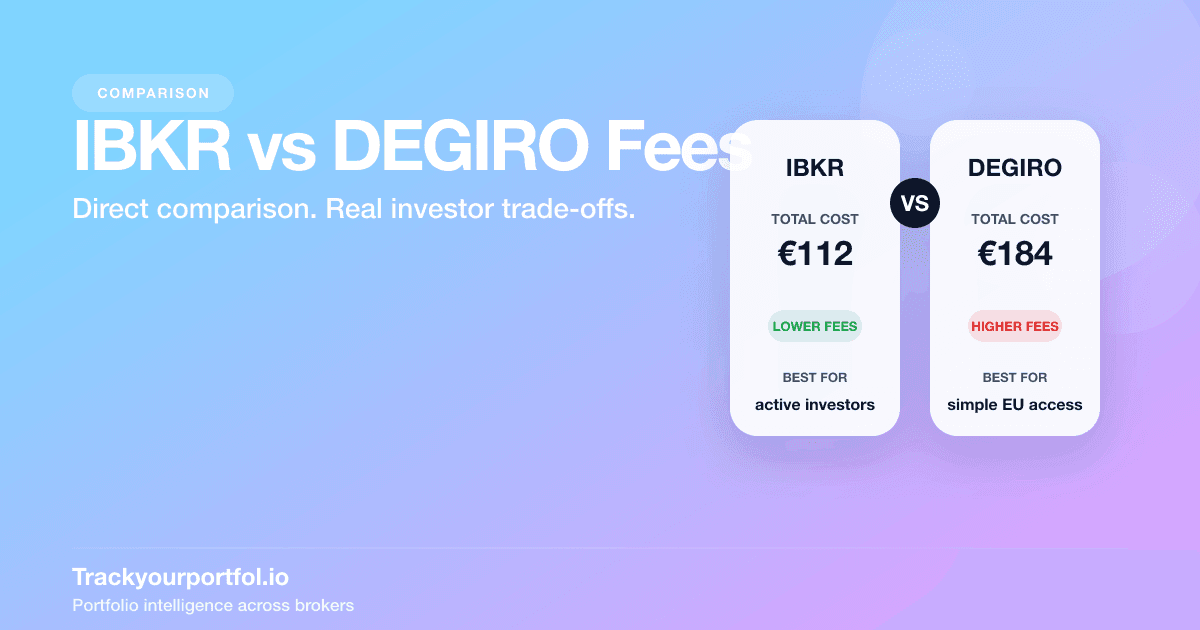
If you want the shortest useful answer, IBKR is usually cheaper than DEGIRO for European investors buying USD stocks or ETFs, investing across currencies, or running a more global portfolio. DEGIRO can still be cheaper for a smaller EUR-only ETF portfolio, especially if you stay inside the Core Selection. The break point is usually not the trading commission. It is the FX conversion and the way your broker mix changes over time.
- IBKR usually wins if you invest in USD regularly, care about FX costs, or want broader market access.
- DEGIRO can still win if you mainly buy EUR-listed ETFs, keep the portfolio simple, and want the lighter workflow.
- The fastest next step is to compare your own trade size, currency mix, and ETF behavior instead of copying a generic ranking.
DEGIRO charges 0.25% on currency conversion, while Interactive Brokers charges roughly 0.002% with a small minimum fee. On larger recurring investments, that gap can overwhelm the headline commission difference and become the main reason IBKR wins on total cost for global investors.
Use this guide to understand the fee table and investor-profile trade-offs. Then run your own numbers in the broker fee comparison tool before switching, adding a second broker, or assuming one platform is always cheaper.
IBKR vs DEGIRO at a Glance: 2026 Fee Comparison Table
If you searched “IBKR vs DEGIRO fees” for the quick answer, start here. The table below covers the cost lines that usually decide the broker choice for European investors.
| Fee area | IBKR | DEGIRO | Practical takeaway |
|---|---|---|---|
| FX conversion | About 0.002% with a small minimum fee | 0.25% per conversion | IBKR is dramatically cheaper for EUR investors buying USD assets regularly. |
| US stock commissions | Fixed or tiered pricing, often around USD 1 minimum | EUR 1 commission + EUR 1 handling fee | Difference is small for occasional trades, but IBKR usually wins for active investors. |
| ETF trading | Low paid commissions, no free ETF list | Core Selection can be very cheap for eligible ETFs | DEGIRO can win for simple EUR ETF buying; IBKR wins once FX matters. |
| Connectivity / market access | No separate connectivity fee in typical use | Connectivity fees can apply for foreign exchanges | Small cost, but another edge for IBKR if you use multiple markets. |
| Custody / inactivity | No custody fee, no inactivity fee | No custody fee, no inactivity fee | Draw on headline maintenance costs. |
| Margin and cash economics | Generally stronger margin pricing and cash interest policies | Typically less attractive for leverage or idle cash | IBKR is usually better for advanced investors and larger balances. |
| Best fit | Multi-currency, active, global, or two-broker investors | Simple EUR-only portfolios and investors who value simplicity | Choose based on workflow, not just one headline fee. |
If your next question is not “which one is cheaper in theory?” but “which one is cheaper for my actual investing pattern?”, use our broker fee comparison tool with your monthly contribution, average trade size, and currency mix. If you want the DEGIRO-specific cost stack in more detail first, read our DEGIRO hidden fees breakdown.
Stock Trading Commissions: Close on Small Trades, Wider Over Time
For US stocks, DEGIRO charges a flat EUR 1 commission plus a EUR 1 handling fee, which means about EUR 2 per trade before you think about FX. Interactive Brokers uses fixed or tiered pricing. On the fixed model, US stock trades cost USD 0.005 per share with a USD 1 minimum and a maximum of 1% of trade value. On a typical 50-share trade worth around USD 5,000, the IBKR commission lands near the minimum.
For European exchanges, DEGIRO pricing varies by market, while IBKR fixed pricing typically starts lower for smaller trades and becomes more attractive as order size or trading frequency grows. For investors making only a handful of trades per month, the commission difference is rarely the deciding factor. For active investors, IBKR's pricing structure compounds into a more meaningful advantage.
This is why broker-fee comparisons that focus only on commission tables often mislead. The commission gap exists, but it is usually not the biggest number in the annual cost stack.
ETF Costs: DEGIRO Can Win the Simple Case
DEGIRO's Core Selection is the part of the comparison that keeps the broker competitive. If you are a buy-and-hold investor using eligible EUR-denominated ETFs and trading within the fair-use rules, DEGIRO can be genuinely cheap in practice. That matters for smaller portfolios where simplicity matters more than platform depth.
IBKR does not offer a commission-free ETF list, but ETF commissions are still low under fixed or tiered pricing. Once your ETF workflow includes foreign-currency purchases, larger ticket sizes, or broader global exposure, the FX advantage at IBKR often wipes out DEGIRO's Core Selection edge.
Put differently: for ETF investors, the right question is not “does one broker advertise zero commission?” It is “how much all-in drag do I create over a year of buying, reinvesting, and converting currencies?”
FX Conversion Fees: The Biggest Hidden Gap
If you are a European investor buying US-listed stocks or ETFs, you need to convert EUR to USD. This is where the comparison stops being subtle. DEGIRO charges 0.25% on each currency conversion. On a EUR 10,000 purchase, that is EUR 25 gone before the trade has a chance to compound.
Interactive Brokers charges roughly 0.002% for FX conversion, with a small minimum fee. That same EUR 10,000 conversion costs about USD 2. For regular monthly investing, the difference can easily reach low hundreds of euros per year. Over a decade, that becomes a four-figure drag difference.
This is also why many DEGIRO investors feel like the platform is cheap until they finally audit their real cost stack. If you want to see how these hidden costs accumulate beyond the commission line, our DEGIRO hidden fees guide goes deeper on the mechanics.
For investors holding a EUR 100,000 portfolio with meaningful USD exposure, the annual FX drag gap alone can be large enough to dominate the whole broker comparison. That is the core reason IBKR tends to win for globally diversified portfolios.
Connectivity and Platform Costs
DEGIRO charges exchange connectivity fees when you trade outside your home market. The annual cost is capped, so it is not a catastrophic number, but it is still another layer of friction for investors who use several foreign exchanges. Interactive Brokers does not usually add a separate connectivity charge in the same way, which makes the all-in pricing cleaner for multi-market investors.
Neither broker currently charges custody fees or inactivity fees. That matters because older comparison articles often still repeat outdated IBKR inactivity-fee talking points. For most investors today, the more relevant distinction is not maintenance cost. It is whether your investing workflow is single-market and simple, or global and multi-currency.
Interest on Cash and Margin Rates
This section matters less for beginners and more for serious investors with larger balances, temporary cash positions, or occasional leverage. Interactive Brokers generally offers more attractive economics here: margin rates are typically lower, and cash balances above platform thresholds can earn interest.
DEGIRO is less compelling on both fronts. If you never use leverage and rarely hold cash, this may not influence your broker choice. But for larger portfolios, it is another reason the cost gap widens in IBKR's favor as complexity rises.
Which Broker Is Better for Your Investor Profile?
The practical answer depends on who you are as an investor, not on a single fee row.
- Passive EUR-only ETF investor: DEGIRO can still be the better practical choice if you mainly buy eligible Core Selection ETFs, keep the portfolio simple, and value a lighter interface.
- Global ETF or US-stock investor: IBKR usually wins because FX drag becomes a far bigger cost than the headline commission difference.
- Active trader: IBKR is usually stronger once trade frequency, market access, and margin economics matter.
- Two-broker diversifier: Many investors end up with DEGIRO for simpler EUR holdings and IBKR for broader access. In that setup, choosing between brokers is only half the problem. Measuring the portfolio across both becomes the next real job.
Total Cost Comparison: Three Worked Examples
The investor-profile view below is more useful than a generic “IBKR is cheaper” claim because it shows where the cost gap actually comes from.
- EUR 20,000 passive ETF portfolio, mostly EUR-listed funds: DEGIRO and IBKR are both viable. DEGIRO can be slightly cheaper in practice if the ETF purchases fall inside the Core Selection rules and FX conversion is minimal.
- EUR 50,000 global portfolio with monthly USD ETF purchases: IBKR usually becomes clearly cheaper because recurring FX conversion dominates the annual cost stack.
- EUR 150,000 multi-broker investor using EU and US markets: IBKR usually wins on all-in economics, but the bigger operational question becomes how you consolidate performance, fees, and dividends across both brokers.
If you want to model your own pattern instead of mapping yourself to an example, use our broker fee comparison tool. If you also want to estimate the long-term drag from those fees on portfolio growth, follow it with the hidden investment fees calculator.
When DEGIRO Still Wins
DEGIRO still makes sense when your portfolio is relatively small, your investing is mostly EUR-denominated, and your priority is a simple low-friction interface. The Core Selection remains useful for buy-and-hold ETF investors who do not need broad platform depth.
The key is being honest about your own behavior. If you only occasionally buy EUR-listed ETFs, DEGIRO can be a perfectly rational choice. If you think you might add more USD exposure, more markets, or more trading activity later, the cost advantage can reverse faster than many investors expect.
When IBKR Clearly Wins
IBKR tends to win once your portfolio becomes multi-currency, global, or operationally serious. The FX cost gap is the biggest reason, but better market access, stronger margin economics, and a more advanced reporting setup also matter.
That does not mean IBKR is always the more pleasant platform. It means the economics are usually better for investors whose workflow is more complex than “buy one local ETF every month.”
If You Use Both, the Tracking Problem Becomes the Real Problem
Many serious investors end up using both brokers: DEGIRO for some EUR-denominated holdings, IBKR for US stocks, options, or broader market access. That can be a sensible broker stack. But once you split assets across both, the bigger problem is no longer choosing a broker. It is measuring the portfolio correctly.
That is where the workflow should continue. If you need the operational side of IBKR reporting, start with our IBKR Flex Query setup guide. If you need the portfolio-wide process after that, use our multi-broker consolidation guide to build a single view across accounts.
trackyourportfol.io is built for exactly this problem. You can import broker data, including DEGIRO and IBKR exports, consolidate holdings, and analyze real returns, dividends, and fee drag in one place without maintaining another fragile spreadsheet process.
FAQ: IBKR vs DEGIRO Fees
Is IBKR cheaper than DEGIRO for ETF investors? Usually yes if you buy foreign-currency ETFs or invest at larger size, because the FX difference matters more than the commission line. For simple EUR-only ETF investing, DEGIRO can still be competitive.
Is DEGIRO cheaper for small portfolios? It often can be, especially when the portfolio is small, EUR-only, and focused on eligible Core Selection ETFs. The mistake is assuming that stays true once your workflow becomes more global.
What is the biggest hidden difference between IBKR and DEGIRO? FX conversion. That is the cost line most investors underestimate, and it is often the main reason IBKR becomes cheaper over time.
Should you switch brokers based on commissions alone? Usually no. Market access, FX drag, reporting workflow, and whether you will end up running two brokers anyway matter more than shaving a small amount off a single trade.
Model Your Own Fee Stack Before You Switch
The best use of this comparison page is not to copy one of the generic examples above. It is to narrow the decision and then run your own numbers. If you are deciding between IBKR and DEGIRO, use the broker fee comparison tool to compare your actual investing pattern. If you already know your broker mix and want to see what fee drag does to long-term returns, use the hidden investment fees calculator. For a 10, 20, or 30 year benchmark of how those cost differences compound, continue to how broker fees affect returns.
That is the difference between consuming broker content and making a better investor decision.